

In the early days of the United Arab Emirates’ economic boom, “tax” was a word rarely whispered in the hallways of Dubai’s skyscrapers or the bustling souks of Abu Dhabi. That changed on January 1, 2018. The introduction of Value Added Tax (VAT) at a standard rate of 5% transformed the UAE from a purely tax-free haven into a sophisticated, regulated global economy.
For the modern entrepreneur, UAE VAT tax registration is no longer a “maybe”it is a critical milestone of business maturity. Whether you are a solo freelancer operating out of a co-working space, a high-growth e-commerce startup, or a seasoned SME, understanding the nuances of the Federal Tax Authority (FTA) is the difference between a thriving business and one buried under a mountain of AED 10,000 penalties.
This guide is designed to strip away the jargon. We won’t just tell you what the law says; we will tell you exactly how it applies to your bank account, your invoices, and your peace of mind.
What is UAE VAT Registration?
At its simplest, UAE VAT tax registration is the process of notifying the Federal Tax Authority that your business is a “taxable person.” Once registered, the government grants you a 15-digit Tax Registration Number (TRN).
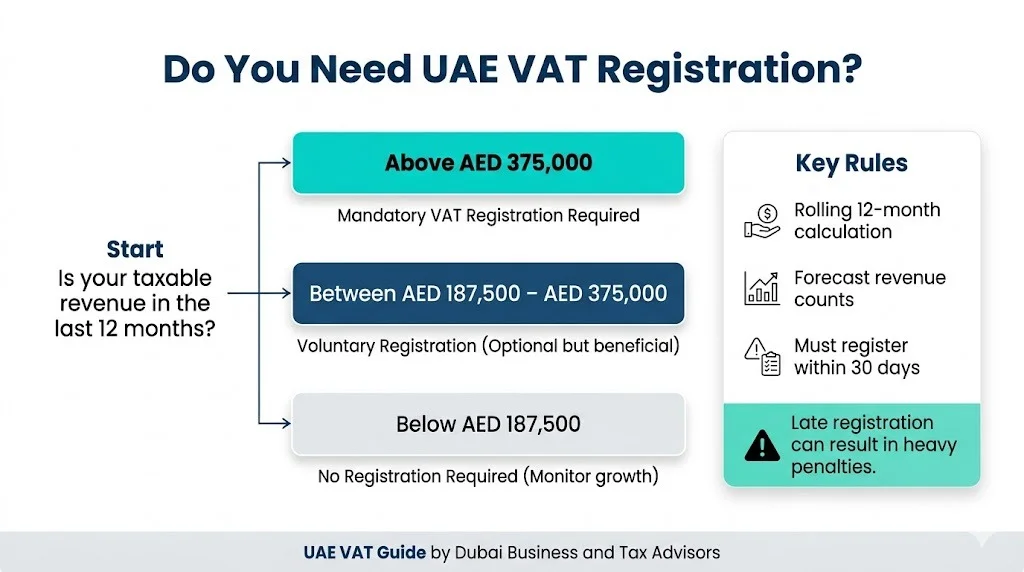
- Mandatory Registration: Required when your taxable turnover exceeds AED 375,000 in the previous 12 months.
- Voluntary Registration: Optional when your turnover (or taxable expenses) exceeds AED 187,500.
- TRN: Think of this as your business’s “tax ID.” Without it, you cannot legally charge VAT or claim back the VAT you pay to your suppliers.
Do You Need to Register for VAT in UAE? (The Decision Engine)
Many business owners live in fear of the “Threshold Monster.” They worry that if they cross a certain line, they’ll wake up to a massive fine. To help you sleep better, we’ve built a logic flow to help you decide your status today.
The Rolling 12-Month Logic
The FTA doesn’t look at the calendar year (January to December). They use a rolling 12-month period. This means at the end of every single month, you must look back at the previous 11 months plus the current month.
If your taxable revenue (R) for any month i follows the formula:
$$\sum_{i=n-11}^{n} R_i \ge 375,000$$
you have 30 days to apply for mandatory registration.
The Next 30 Days Rule
There is a second trigger. If you expect your revenue in the next 30 days alone to exceed the mandatory threshold (perhaps you just signed a massive contract), you must register immediately.
You SHOULD register if:
- You are a B2B company and your clients expect a VAT invoice to recover their own costs.
- You are in a “startup loss” phase with high setup expenses (rent, equipment, stock) and you want to claim that 5% back from the government.
- You have crossed the AED 375,000 mark.
You SHOULD NOT register if:
- Your revenue is well below AED 187,500.
- Your business only deals in “exempt” supplies (like residential local transport or certain financial services), as you physically cannot register for VAT.
UAE VAT Registration Thresholds Explained
Confusion between “taxable,” “zero-rated,” and “exempt” supplies is where most DIY registrations fail.
- Mandatory Threshold (AED 375,000): This is non-negotiable. Failure to register within 30 days of hitting this mark results in a late registration penalty.
- Voluntary Threshold (AED 187,500): This is a “safety net” for growing businesses and startups with high overheads.
- Taxable vs. Exempt: * Taxable supplies (including 0% rated exports) count toward the threshold.
- Exempt supplies (like residential rent or some life insurance) do not count toward the threshold.
Example Scenario: A consultant makes AED 300,000 from local clients and AED 100,000 from exports to Europe. Their total taxable revenue is AED 400,000. Even though they don’t charge 5% on the exports, they must register because the total exceeds AED 375,000.
Mandatory vs. Voluntary Registration: The Strategic Choice
Is it better to wait or jump in early?
The Case for Voluntary Registration
If you are a new startup, you might be spending AED 500,000 on office fit-outs and inventory before you make a single sale. If you register voluntarily (provided you hit the AED 187,500 expense threshold), you can claim back 5% of those setup costs (AED 25,000). That is a significant cash-flow boost. Furthermore, having a TRN adds a layer of corporate credibility when dealing with large multinational vendors.
The Compliance Burden
Once you are in, you are in. You must file returns (usually quarterly), keep meticulous records, and issue proper VAT invoices. If your business is tiny and your clients are individuals (B2C) who can’t claim VAT back, registering voluntarily might actually make you 5% more expensive than your unregistered competitors.
CLICK HERE TO READ MORE ARTICLE
How to Register for VAT in UAE (The FTA Process)?
The process is handled entirely online through the EmaraTax portal. While it looks straightforward, the FTA is famous for being pedantic. A single typo can lead to a rejection.
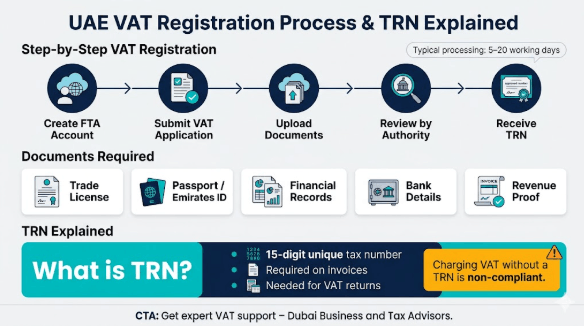
- Create an Account: Sign up on the EmaraTax portal with a valid email and UAE mobile number.
- The Application: You will fill out a multi-page form covering your business activities, owners, and financial projections.
- Upload Documents: This is where most people get stuck (see the checklist below).
- Submission & Review: The FTA typically takes 20 business days to review an application. However, if they ask for “clarifications,” the clock restarts.
Pro-Tip: Don’t wait until day 29 of your 30-day window to start. If the FTA asks for a document you don’t have, you’ll likely miss the deadline and face a fine.
Documents Required: Your VAT Checklist
The FTA wants to see that you are a legitimate, functioning business. They will reject “blurry scans” or “partial documents” without hesitation.
- Trade License: Must be valid and current.
- Certificate of Incorporation: For offshore or specific free zone entities.
- Passport & Emirates ID: For the manager/owner.
- Articles of Association / Partnership Agreement: To verify who has signing authority.
- Proof of Turnover: This is the most critical. You need an income statement, copies of invoices, or a bank statement showing the revenue.
- Customs Details: If you are an importer/exporter (your “Codenumber”).
Common Rejection Reason: The name on the bank statement doesn’t match the name on the Trade License. Ensure your “Trading Name” and “Legal Name” are clearly defined.
What is TRN and How Does It Work?
Your Tax Registration Number (TRN) is a unique 15-digit identifier. It is the “key” to the UAE tax system.
- Invoicing: You are legally forbidden from adding “5% VAT” to an invoice unless your TRN is clearly printed on that invoice.
- Verification: Any client can (and will) verify your TRN on the FTA website to ensure they aren’t being scammed.
- Customs: Your TRN is linked to your customs code to automate VAT on imports.
Critical Rule: If you charge a client VAT before your TRN is issued, you are committing a serious offense. You must wait for the official certificate.
What Happens After Getting Your TRN? (The First 90 Days)
Many entrepreneurs think getting the TRN is the “finish line.” In reality, it is the starting gun.
The First 30 Days: System Setup
You must update your accounting software (Xero, QuickBooks, Zoho) to calculate VAT automatically. You also need to redesign your invoice template to meet FTA “Tax Invoice” standards, which include specific wording, the currency (AED), and the VAT breakdown per line item.
The First 90 Days: Your First Return
The FTA will assign you a “Tax Period.” At the end of this period, you have 28 days to file your return. This is where you report your Output VAT (collected from sales) and subtract your Input VAT (paid to suppliers).
The Formula:
VAT Payable=Total Output VAT−Total Recoverable Input VAT
VAT Registration Mistakes That Cost Businesses Money
We have seen businesses lose hundreds of thousands of dirhams not because they were “dodgy,” but because they were disorganized.
1. Late Registration (The AED 10,000 Surprise)
If you hit the AED 375,000 threshold in March and don’t apply by the end of April, the FTA’s system will automatically flag you. The penalty is AED 10,000. No excuses, no appeals.
2. Incorrect Revenue Calculation
Some businesses exclude their “Zero-Rated” exports from their threshold calculation. This is a mistake. Exports are taxable at 0%, which means they do count toward the AED 375,000 limit.
3. Charging VAT Without a TRN
Charging 5% while your application is “Pending” is considered tax fraud. If you have hit the threshold but don’t have a TRN yet, you should inform clients that you will issue a “Debit Note” once the TRN arrives.
Special Cases: Freelancers, E-commerce, and Free Zones
Freelancers & Consultants
If you are a freelancer with a permit (like those from GoFreelance or SHAMS), you are considered a “Taxable Person.” If your services to UAE clients exceed the threshold, you must register. Many freelancers ignore this until they try to work with a large corporate client who refuses to pay without a TRN.
E-commerce
E-commerce businesses often have complex “Place of Supply” rules. If you are selling to customers in the UAE, those sales are taxable. If you are a non-resident selling via Amazon UAE, you might have a zero-threshold registration requirement meaning you must register from the very first dirham you earn.
Free Zone Companies
The “Tax-Free” nature of Free Zones often refers to Corporate Tax, not VAT. Most Free Zone companies are still subject to the 5% VAT if they trade within the UAE or provide services locally.
Can You Cancel Your VAT Registration?
Deregistration is mandatory if:
- The business stops making taxable supplies.
- Revenue falls below the voluntary threshold (AED 187,500) and isn’t expected to rise.
You have 20 business days to apply for deregistration once you become eligible. Failing to do so results in an AED 10,000 fine. The FTA is very strict about keeping their database clean.
How Dubai Business and Tax Advisors Supports Your VAT Registration?
Dubai Business and Tax Advisors simplifies the entire uae vat tax registration process so you can stay compliant without stress.
- Eligibility Assessment: Clear advice on whether and when you should register
- Complete Registration Handling: Accurate FTA application with minimal rejection risk
- TRN & Setup Support: Guidance on invoices, compliance, and next steps
- Ongoing VAT Compliance: Help with filings, records, and avoiding penalties
You get expert support from registration to full compliance so you can focus on growing your business.
Frequently Asked Questions
What is the VAT registration threshold in the UAE and when must I register?
Mandatory VAT registration is required if your taxable supplies and imports exceed AED 375,000 in the past 12 months or are expected to exceed this in the next 30 days. Voluntary registration is available if your taxable supplies exceed AED 187,500. You must apply within 30 days of crossing the mandatory threshold to avoid penalties. Registration is done through the Federal Tax Authority (FTA) portal.
What is a TRN and how do I get one?
A TRN (Tax Registration Number) is your unique 15-digit VAT identification number issued by the FTA after successful registration. You receive it once your VAT registration application is approved, typically within 20 business days if all documentation is correct. Your TRN must appear on all tax invoices, and you’ll use it for filing VAT returns and communicating with the FTA.
What documents do I need to register for VAT in the UAE?
You’ll need a valid trade license, Emirates ID and passport copies of authorized signatories, Memorandum of Association, bank account details, and financial records proving your turnover. For some business activities, additional sector-specific documents may be required. Incomplete or incorrect documentation is the most common reason for registration delays, so ensure everything is accurate before submitting.
How often do I need to file VAT returns and what are the deadlines?
Most businesses file VAT returns quarterly, due within 28 days after the end of each tax period (e.g., Q1 return due April 28). Larger businesses with annual taxable supplies over AED 150 million must file monthly. Late filing incurs automatic penalties starting at AED 1,000, increasing with continued delays. Payment of VAT owed is also due within the same 28-day deadline.
What happens if I don’t register for VAT when required?
Failure to register for VAT when you’ve crossed the threshold results in immediate penalties AED 10,000 for the first violation, plus potential back-calculation of VAT owed from the date you should have registered. You cannot recover input VAT for periods before registration, meaning you lose money on VAT you’ve already paid to suppliers. The FTA actively monitors businesses and can impose additional fines for deliberate non-compliance.
Common VAT Registration Myths
- “VAT is optional for small businesses.” False. It is mandatory for anyone over the threshold.
- “Only big businesses get audited.” False. The FTA uses automated algorithms to flag small businesses with inconsistent filing patterns.
- “I can delay registration until the end of the year.” False. The rolling 12-month rule means you could become liable at any time during the year.
Conclusion
UAE VAT tax registration is a sign that your business has arrived. It means you are part of the formal UAE economy, contributing to the nation’s infrastructure and growth. But it is also a legal minefield.
The difference between a seamless registration and a rejected application often comes down to the quality of your financial records and the precision of your submission. Why risk a massive penalty or a “blocked” customs code?
At Dubai Business and Tax Advisor, we specialize in taking the weight of the FTA off your shoulders. We don’t just “fill in forms”; we analyze your revenue, vet your documents, and handle the entire EmaraTax communication on your behalf.
Ready to get your TRN without the stress? Contact us today for a free VAT threshold assessment.
Disclaimer
This content is for general informational purposes only and does not constitute legal, tax, or financial advice. VAT laws, FTA requirements, thresholds, and penalties may change over time and may vary depending on your business activity, structure, and jurisdiction. You should consult a qualified tax advisor or legal professional before making any business or tax decisions.